
Stop switching to English. A2 is where Dutch takes over.
Our A2 courses turn your basics into everyday Dutch you actually use — at the market, on the phone, and with the neighbours who keep switching to English.
- Neighbour
Lekker weertje, hè? Eindelijk!
Lovely weather, right? Finally!
- You
Ja, heerlijk! Ga je nog iets leuks doen dit weekend?
Yes, wonderful! Doing anything fun this weekend?
- Neighbour
We gaan naar de markt. En jij?
We’re going to the market. And you?
- You
Ik ga fietsen met een vriendin — als het droog blijft.
I’m going cycling with a friend — if it stays dry.
Upcoming A2 start dates
Live availability — dates, prices and seats come straight from our course planning.
Dutch A2.1 Intensive Course
- Starts: October 6, 2026
- When: Tuesday & Thursday, 20:30–21:30
- Teacher: Lorenzo Loorbach
Need different days or times?
Tell us which days of the week and times you could study A2 — we plan new start dates around what people ask for, and contact you when a group that fits opens.
Request a class that fits your weekNot sure which level you are?
Tell us a little about your Dutch and we'll tell you where to start — free, in English, not a test.
Book a free level checkWhat you'll learn — the A2 route
3 blocks of ten one-hour lessons, each a complete course with its own start dates. You pay per block, and your teacher tells you exactly what to take next.
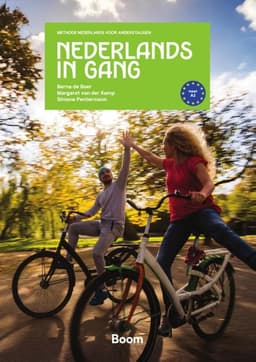
Nederlands in gang · Boom
All group lessons at this level follow Nederlands in gang, a standard NT2 course book used across Dutch language education. The book itself is not included in the course price — order your own copy so you can write in it and keep it.
View and order- Block 1 · A2.1
Repairs, celebrations & finding your way
Course book chapters 10–12 · Bij de fietsenmaker · Op een verjaardag · Naar de Evenementenhal
What you can do: Explain issues with your bike, ask how to say things in Dutch, chat about work, studies and hobbies at parties, and ask for or give route directions.
Grammar focus
- Simple past tense (imperfectum) of regular, irregular and modal verbs
- Combining past tenses (perfectum vs. imperfectum)
- Reflexive verbs (zich herinneren, zich voorstellen…)
- Reciprocal pronouns & possession (elkaar, bij zich hebben)
- Separable verbs (scheidbare werkwoorden, e.g. overstappen, meenemen)
- Block 2 · A2.2
Socialising, fitness & travelling
Course book chapters 13–15 · Bij vrienden · In de sportschool · In de trein
What you can do: Make small talk (koetjes en kalfjes), express opinions, ask for information at a gym, talk about sports, travel by train, and describe what you see or write a holiday postcard.
Grammar focus
- Promises and probability using zullen (belofte & waarschijnlijkheid)
- Future tense (futurum) with zullen + infinitive
- Independent demonstrative pronouns (demonstratief pronomen — zelfstandig)
- Pointing out objects and people (Dit is / zijn…, Dat is / zijn…)
- Block 3 · A2.3
Entertainment, daily routines & emergencies
Course book chapters 16–18 · Naar de bioscoop · Thuis · Bij de politie
What you can do: Invite someone to the cinema, make phone calls and send text messages, describe continuous daily activities at home, report an incident to the police (aangifte doen), and give or ask for advice.
Grammar focus
- Conjunctions and complex clause structures (conjuncties, e.g. omdat, want, als…)
- Using er and daar for locations and references
- Continuous aspect (zijn aan het + infinitive: Ik ben aan het koken)
- Asking for and giving advice (advies vragen en geven)
What is A2 Dutch?
A2 is the second CEFR level, one step above beginner. At A2 you can handle everyday Dutch: shopping, directions, appointments, small talk about work and family, and short practical messages. You understand routine conversations when people speak clearly. Our A2 courses build on a completed A1 (or the equivalent) in three sub-levels — A2.1, A2.2 and A2.3 — taught live online by native Dutch teachers.
The CEFR is the six-level European standard for language ability. Our group courses run A1–B2; beyond that, C1 coaching is private and on request.
And after A2? After A2, daily life runs in Dutch without a safety net — and you’re ready for B1, the jump from surviving in Dutch to living in it.
How the course runs
You speak in every single lesson
Live video classes capped at eight students — small enough that speaking Dutch isn't optional, it's the whole point. Not a webinar, not an app. We're an Amsterdam school; you join from wherever you are.
NT2-certified native teachers
Native speakers with the NT2 teaching certification — professionally trained to teach Dutch as a second language, not just to speak it. They benchmark your progress against the official CEFR scale and tell you the truth about it.
Ten focused lessons per block
Each block is ten live lessons of 60 minutes, typically meeting twice a week — one complete step of your level with its own start date and price, so you always know exactly what you are committing to.
Never lose the thread
Notes and materials are shared after every class, so a missed session doesn't become a lost week — you catch up before the next lesson and walk in ready.
"The teachers are knowledgeable, professional, engaging, and supportive. I started at the A1 level and have been very satisfied with my progress, so I will definitely continue my studies with them."
Stella Perziani
Group course · from A1 · Google review
Real 5-star review from our students on Google.
A2 questions, straight answers
Should I start at A2 or go back and repeat A1?
What’s the difference between A1 and A2 in practice?
Can I combine the A2 course with conversation practice?
How long does A2 take?
What happens if I miss a class?
Stop translating. Start talking.
Pick an A2 start date below — or book a free level check first and we’ll confirm the right block before you spend a euro.