
Dutch for beginners, done properly
A live online A1 course with a native Dutch teacher — a small group, real sentences out loud from lesson one, and honest feedback on where you stand.
- Barista
Hoi! Zeg het maar.
Hi! What can I get you?
- You
Eén cappuccino, alstublieft.
One cappuccino, please.
- Barista
Lekker. Anders nog iets?
Nice. Anything else?
- You
Nee, dat was het. Dank je wel!
No, that’s it. Thank you!
Upcoming A1 start dates
Live availability — dates, prices and seats come straight from our course planning.
Dutch A1.2 Intensive Course
- Starts: October 5, 2026
- When: Monday & Wednesday, 20:00–21:00
- Teacher: Lorenzo Loorbach
Dutch A1.1 Intensive Course
- Starts: October 6, 2026
- When: Tuesday & Thursday, 18:30–19:30
- Teacher: Lorenzo Loorbach
Need different days or times?
Tell us which days of the week and times you could study A1 — we plan new start dates around what people ask for, and contact you when a group that fits opens.
Request a class that fits your weekNot sure which level you are?
Tell us a little about your Dutch and we'll tell you where to start — free, in English, not a test.
Book a free level checkWhat you'll learn — the A1 route
3 blocks of ten one-hour lessons, each a complete course with its own start dates. You pay per block, and your teacher tells you exactly what to take next.
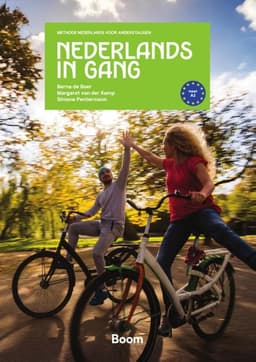
Nederlands in gang · Boom
All group lessons at this level follow Nederlands in gang, a standard NT2 course book used across Dutch language education. The book itself is not included in the course price — order your own copy so you can write in it and keep it.
View and order- Block 1 · A1.1
First conversations & basics
Course book chapters 1–3 · Welkom · In de kantine · In het café
What you can do: Introduce yourself, spell names, talk about your family, tell the time, make basic conversation at work or school, and order food or drinks at a café.
Grammar focus
- Present tense verbs & subject pronouns (ik, jij, hij…)
- Standard sentence structure (hoofdzin) & question forms (yes/no questions and question words)
- Inversion — changing word order after time/place (Morgen werk ik)
- Possessive pronouns (mijn, jouw…)
- Articles (de / het / een) & ordinal numbers
- Block 2 · A1.2
Going out, shopping & making plans
Course book chapters 4–6 · Op straat · Op de markt · In een restaurant
What you can do: Greet people on the street, arrange meetups, buy fresh produce at the market, ask about prices, and order full meals or ask for the bill at a restaurant.
Grammar focus
- Making suggestions using zullen (Zullen we koffie drinken?)
- Plural nouns (meervoud)
- Adjective endings (een grote appel vs. een groot huis)
- Giving commands & instructions (imperatief)
- Modal verbs for wishes, abilities and duties (willen, kunnen, moeten, mogen)
- Block 3 · A1.3
Everyday living, housing & health
Course book chapters 7–9 · In een kledingzaak · Bij de makelaar · Bij de huisarts
What you can do: Shop for clothes (sizes, fits, colours), look for a room or house with an estate agent, describe home furnishings, and explain physical health complaints to a doctor (de huisarts).
Grammar focus
- Comparatives and superlatives (mooi, mooier, mooist)
- Demonstratives (deze, die, dit, dat) & object pronouns (mij, jou, hem…)
- Negation with niet and geen
- Spatial prepositions (in, op, naast…) & indefinite words (iets / niets)
- The present perfect tense (het perfectum) to talk about past events
What is A1 Dutch?
A1 is the first level of the CEFR, the six-step scale (A1 to C2) used across European language education. At A1 you can introduce yourself, ask and answer simple questions, handle everyday phrases, and understand people who speak slowly and clearly. Our A1 courses take you there from zero, in three sub-levels (A1.1, A1.2, A1.3) taught live online by native Dutch teachers.
The CEFR is the six-level European standard for language ability. Our group courses run A1–B2; beyond that, C1 coaching is private and on request.
And after A1? After A1, everyday exchanges stop being scary — and you’re ready for A2, where real everyday independence starts.
How the course runs
You speak in every single lesson
Live video classes capped at eight students — small enough that speaking Dutch isn't optional, it's the whole point. Not a webinar, not an app. We're an Amsterdam school; you join from wherever you are.
NT2-certified native teachers
Native speakers with the NT2 teaching certification — professionally trained to teach Dutch as a second language, not just to speak it. They benchmark your progress against the official CEFR scale and tell you the truth about it.
Ten focused lessons per block
Each block is ten live lessons of 60 minutes, typically meeting twice a week — one complete step of your level with its own start date and price, so you always know exactly what you are committing to.
Never lose the thread
Notes and materials are shared after every class, so a missed session doesn't become a lost week — you catch up before the next lesson and walk in ready.
"I have really enjoyed the Dutch classes I have attended at GoBeyondDutch! Lorenzo is an amazing teacher and as a beginner it was a smooth learning process."
Benedetta Iurilli
Beginner course · Google review
Real 5-star review from our students on Google.
A1 questions, straight answers
Is A1 the right level if I already know a few words?
How long does it take to finish A1?
Are the lessons taught in English or in Dutch?
What happens if I miss a class?
Do I need to buy books or materials before the course starts?
Your first Dutch sentence is closer than you think
Join an A1 group and start speaking from lesson one — or book a free level check first if you’d rather talk it through. In English, of course.